
April 11th – 14th, 2027
Universidade Presbiteriana Mackenzie, São Paulo - Brazil
Organizers


Sponsors

The Brazilian Optics and Photonics Society (SBFoton) and Mackenzie Presbyterian University proudly announce the organization of the 2027 SBFoton International Optics and Photonics Conference, SBFoton IOPC 2027. The eighth edition of this successful conference will be held in São Paulo, from April 11th to 14th, 2027.
SBFoton IOPC focuses on a broadband approach to optics and photonics-related technologies. It is primarily designed to report on the latest findings in Agriphotonics, Biophotonics, Integrated Photonics and Optoelectronics, Lasers, Optical Communication, Optics and Instrumentation, Optical quantum technologies, Sensors, Images, and Illumination.
The organizing and technical program committees plan an event with parallel (technical sessions) and shared (plenaries and social events) agendas. The SBFoton IOPC 2027 will follow the typical format of conferences that include technical sessions with the presentation of peer-reviewed papers, Plenary and Invited Talks and poster sessions.
The SBFoton IOPC 2027 welcomes original contributions in the following and other related relevant topics:
Paper registration and upload opening
October 5th, 2026
Deadline for paper registration and upload
November 30th, 2026
Registrations Open
February 1st, 2027
Acceptance notification
February 5th, 2027
Camera-ready upload
March 1st, 2027
Conference
April 11st – 14th, 2027
Manuscript Preparation
EDAS submission
Acceptance will be communicated by February 5th 2027, and final versions of accepted papers must be uploaded up to March 1st 2027.
Plenary Speakers
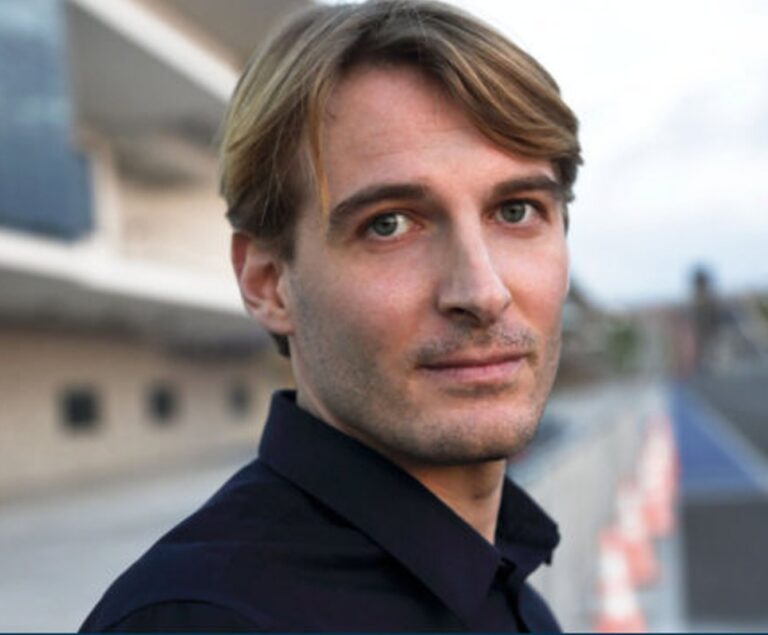
Andrea Alu
The City University of New York – USA
Tailoring material fluctuations with nonlocal and Floquet metasurfaces
In this talk, I will discuss our recent progress in the area of light manipulation using strongly coupled light-matter oscillations in engineered materials featuring lattice resonances and time-driven phenomena. I will discuss the opportunities to control and tailor photons at the nanoscale to enable control over thermal radiation and incoherent processes, based on spatially and/or temporally periodic patterns in metasurfaces. During the talk, I will discuss the exotic phenomena supported by these photonic engineered structures, and their opportunities for classical and quantum light applications.

Andreas Tittl
Ludwig-Maximilians-Universität München – Germany
Loss by Design: Bound States in the Continuum from Molecular Fingerprints to Topology
Bound states in the continuum enable dielectric metasurfaces to confine light with extreme near-field enhancements and high quality factors. I will show how this single principle powers three advances from my group: label-free molecular fingerprinting and AI-assisted biosensing; permittivity-driven, actively reconfigurable metasurfaces culminating in new symmetry-protected BIC concepts for ultrafast resonance control; and van der Waals nanophotonics in crystals such as rhenium disulfide that open a path to topological photonics. Together, these advances show how a single principle, the control of radiative loss, is becoming a remarkably versatile engine for nanophotonic discovery.

Fetah Benabid
XLIM Institut de Recherche, Univ. de Limoges, CNRS - France
Hollow-Core PCF: Specialty fiber and AI-scale Datacom Fiber
Since their emergence as a scientific concept, hollow-core photonic crystal fibers (HCPCFs) have evolved from a fascinating curiosity into both a versatile platform for unique gas-based photonic devices and a compelling candidate for next-generation datacom and telecom transmission. Through a historical account of this evolution, this talk will highlight the remarkable synergy between three interconnected drivers: fundamental science, fabrication technology, and applications. Advances in understanding how light can be confined and guided in a hollow core inspired new fiber structures and guidance mechanisms. In parallel, innovations in fabrication enabled increasingly sophisticated designs to be fabricated with greater precision and control. These advances opened new application opportunities, whose requirements and challenges, in turn, stimulated further developments in fiber science and technology. This continuous feedback between understanding, making, and applying HCPCFs has driven extraordinary progress in their performance and capabilities.
The talk will trace how this interplay enabled HCPCFs to develop along two major directions: as a platform for unique and varied light–gas interactions and novel photonic devices, and as an ultra-low-nonlinearity, low-latency transmission medium with rapidly decreasing loss. The latter is now bringing HCPCFs into the performance regime required by the unprecedented demands from artificial intelligence and hyperscale data centers for faster, higher-capacity, and more energy-efficient data transport. The talk will conclude with the remaining scientific and industrial challenges and the pathway toward widespread HCPCF deployment in future communication systems.
Brazilian Residents
| Early Registration (until Feb 28th) | Standard Registration (from March 1st) | |
| Full Registration – SBFoton Affiliate | ||
| Professional1 | R$ 1.000,00 | R$ 1.300,00 |
| Postdoc & Graduate student2 | R$ 700,00 | R$ 1.000,00 |
| Undergraduate student | R$ 450,00 | R$ 650,00 |
| Full Registration – IEEE Photonics Society (IPS) / Optica / SPIE Affiliate | ||
| Professional1 | R$ 1.200,00 | R$ 1.500,00 |
| Postdoc & Graduate student2 | R$ 900,00 | R$ 1.200,00 |
| Undergraduate student | R$ 550,00 | R$ 750,00 |
| Full Registration – Non-members | ||
| Professional1 | R$ 1.500,00 | R$ 1.800,00 |
| Postdoc & Graduate student2 | R$ 1.100,00 | R$ 1.400,00 |
| Undergraduate student | R$ 650,00 | R$ 850,00 |
International Participants (outside Brazil)
Early Registration (until Feb 28th) | Standard Registration (from March 1st) | |
| Full Registration – SBFoton / IEEE Photonics Society (IPS) / Optica / SPIE Affiliate | ||
| Professional1 | US$ 500,00 | US$ 600,00 |
| Postdoc & Graduate student2 | US$ 300,00 | US$ 400,00 |
| Undergraduate student | US$ 150,00 | US$ 200,00 |
| Full Registration – Non-members | ||
| Professional1 | US$ 700,00 | US$ 800,00 |
| Postdoc & Graduate student2 | US$ 500,00 | US$ 600,00 |
| Undergraduate student | US$ 250,00 | US$ 300,00 |
| One Day Participation3 | ||
| Professional1 | R$ 500,00 | R$ 650,00 |
| Postdoc, Graduate and Undergraduate student | R$ 350,00 | R$ 500,00 |
| Extra Dinner Ticket | R$ 250,00 | R$ 250,00 |
¹ The “Professional” registration gives the right to attend the conference, to get one ticket for the confraternization dinner, and to publish up to TWO papers in the IEEE Xplore.
² “Postdoc, Graduate and Undergraduate” registrations give the right to attend the full conference, to get one ticket for the confraternization dinner, and to publish ONLY ONE paper in the IEEE Xplore.
³ One Day is for participants who wish to attend the conference in only ONE DAY and gives the right to attend the plenaries and technical sessions
⁴ Registrations are not transferable or exchangeable between categories. If you have any questions, please contact the organization.
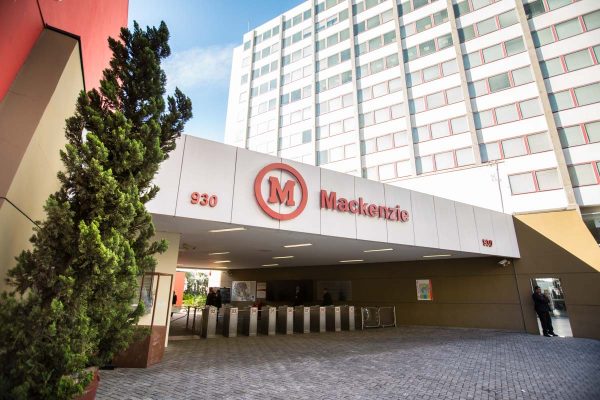
Mackenzie Presbyterian University
Rua da Consolação, 930
Consolação
São Paulo/SP – Brasil
Subway:
Estação Higienópolis-Mackenzie (Metrô – Linha 4 Amarela)
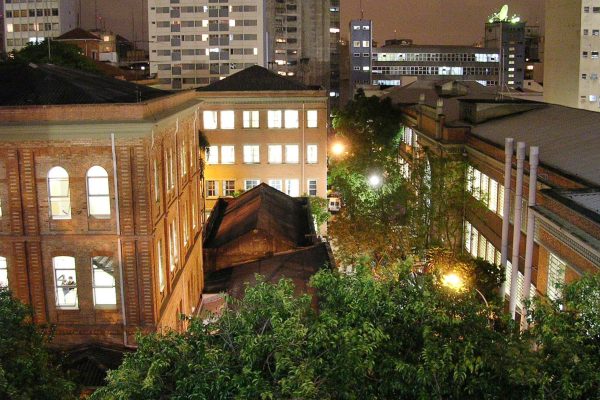
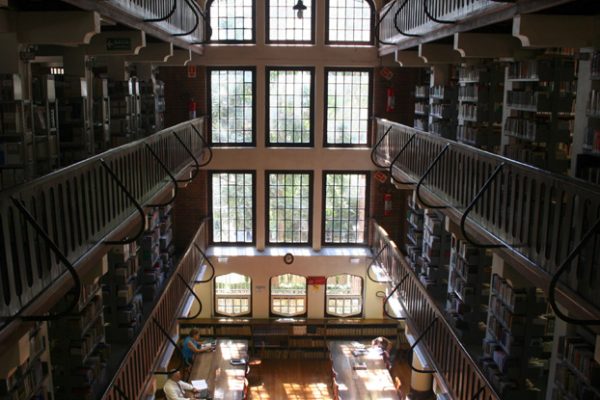
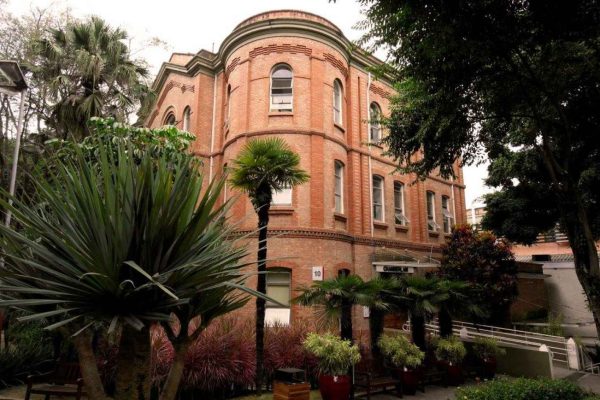
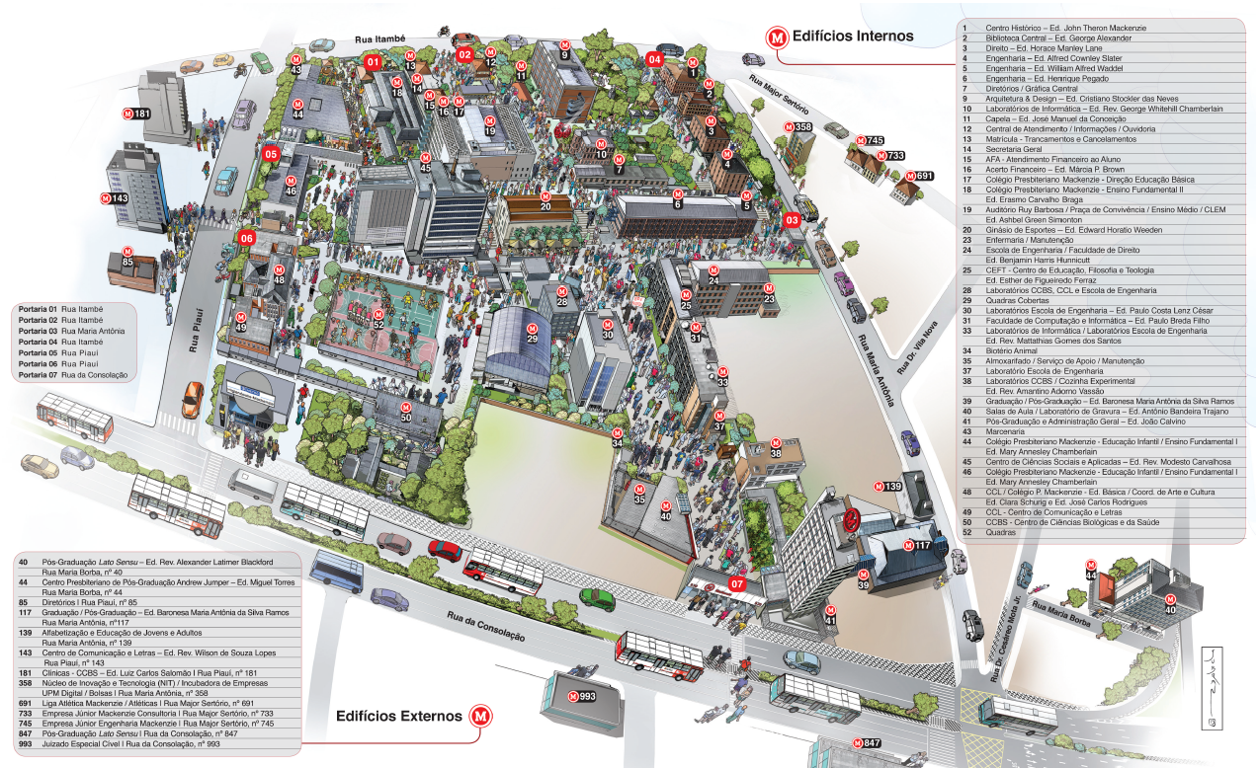
Access points and event areas
Morning Plenaries
Auditório Ruy Barbosa (Building #19)
Access through Gateway 02 – Rua Itambé
Afternoon Plenaries
CCSA – Edifício Rev. Modesto Carvalhosa (Building #45)
Access through Gateway 06 – Rua Piauí
Coffee breaks, Poster Sessions and Parallel Sessions
Courtyard (Building #29)
Access through Gateway 06 – Rua Piauí and Gateway 07 – Rua da Consolação
click to expand
Organizing Committee
General Organization
Advisory Board:
Technical Chairs:
Local Organizing Committee (Mackenzie/SP)
Student Chapters organization
Sponsor organization
Technical Program Committee
Agriphotonics
Biophotonics
Integrated Optics and Optoelectronics:
Lasers
Optical Communication
Optical Instrumentation and Metrology
Optical Fibers and Applications
Photonics and Quantum Technologies
Sensing, Imaging and Illumination
Mackenzie Presbyterian University
Rua da Consolação, 930
Consolação
São Paulo/SP – Brasil
Subway:
Estação Higienópolis-Mackenzie (Metrô – Linha 4 Amarela)